


Welcome!
STEM thinking starts with spatial reasoning.
You can’t solve what you can’t see. Spatial skills enable you to visualize and manipulate objects in your mind’s eye. They’re the hidden foundation of STEM achievement. Alytica delivers free, science-backed tools to develop these skills at any age.
What We Do
1
Spatial Education Research
Because they enable individuals to think in 3D, allowing them to visualize and manipulate objects mentally. This ability forms the fundamental basis for success in STEM fields, as it is essential for effective problem-solving.
2
Advocate and Educate
Because they enable individuals to think in 3D, allowing them to visualize and manipulate objects mentally. This ability forms the fundamental basis for success in STEM fields, as it is essential for effective problem-solving.
3
Develop Educational Tools
Because they enable individuals to think in 3D, allowing them to visualize and manipulate objects mentally. This ability forms the fundamental basis for success in STEM fields, as it is essential for effective problem-solving.
4
Provide Resources
Because they enable individuals to think in 3D, allowing them to visualize and manipulate objects mentally. This ability forms the fundamental basis for success in STEM fields, as it is essential for effective problem-solving.
1
Spatial Reasoning Research
2
Advocacy for Spatial Equity
3
Provide Tools to Educators
4
Provide Activities for Parents
what we do
Research and Compile
Alytica is a Lorem Ipsum is simply dummy text of the printing and typesetting.
Advocate and Educate
Alytica is a Lorem Ipsum is simply dummy text of the printing and typesetting.
Develop Educational Tools
Alytica is a Lorem Ipsum is simply dummy text of the printing and typesetting.
Provide Resources
Alytica is a Lorem Ipsum is simply dummy text of the printing and typesetting.
Why This Matters
STEM subjects and learning depends on spatial skills
By just thirteen years old, a students’ spatial ability predicts if they will go into, succeed, and even innovate in STEM. Without strong spatial reasoning, students hit invisible walls, fall behind in math and science, and often drop out of the STEM altogether. Training spatial skills can improve grades across the board—from math, physics, and engineering to computer science, chemistry, and even the SAT.
Many students hit a wall in physics, not because they are bad with numbers, but because they lack strong spatial reasoning. Physics constantly asks learners to imagine how objects move and interact in space—to visualize forces, motion, and fields they can’t directly see. Whether drawing force diagrams, calculating trajectories, or mapping equations onto real 3D systems, students depend on spatial skills to make sense of the subject. Without them, even basic mechanics is challenging, and more advanced ideas like multi-body systems, electron orbitals, and relativity become much harder to grasp.

Spatial training boosts students' grades in computer science. Why? Coding isn't just logic--students need to visualize what’s happening in the computer. Good code starts with mentally organizing how code, data, and systems fit and work together—like assembling a puzzle in the mind and translating it into text. Spatial reasoning is foundational to this process.

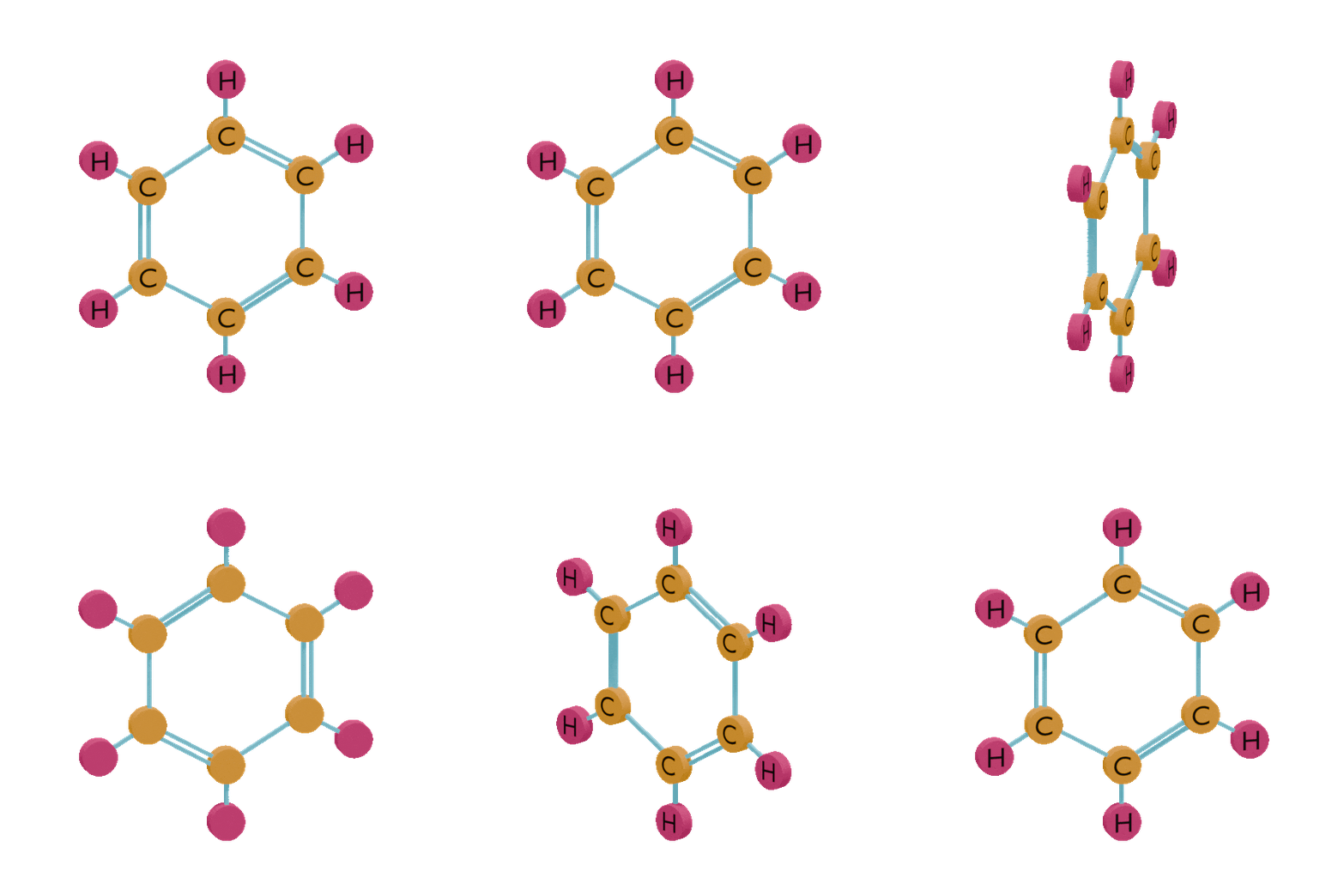
Students’ spatial ability predicts their performance in organic chemistry. Chemists rely on spatial skills to visualize molecular structures in 3D space and to anticipate how those molecules will interact. Strong spatial reasoning helps students mentally simulate collisions, reactions, and multi-step syntheses, leading to better problem-solving and higher achievement.
Your average engineering student is in the top 10% for spatial ability, and students who enter engineering programs without strong spatial skills are at higher risk of underperforming and dropping out. The problem is so widespread that more than 70 engineering schools across the U.S. now screen incoming students for spatial deficits and offer corrective spatial training courses.
Engineers rely heavily on spatial reasoning to visualize how parts fit together, interpret technical drawings, mentally rotate components, create CAD models of 3D parts, and imagine how a design will function before anything is built

Research shows that strong spatial skills predict higher math achievement—including better grades and higher SAT math scores—while students with weak spatial skills often struggle in areas like geometry, trigonometry, and calculus. Whether visualizing parts of a whole, picturing how equations translate into graphs, or mentally manipulating complex geometric shapes, spatial skills are foundational to success across all levels of mathematics.

Biology students tend to have above-average spatial skills because the field requires the visualization of biological systems in 3D. For example, visualizing how proteins fold into functional shapes or interpreting diagrams of metabolic pathways. In medicine, spatial skills are essential for mastering anatomy—mapping how organs, muscles, and bones fit together—and they play a major role in areas like arthroscopic surgical training, where strong spatial ability speeds learning, reduces errors, and leads to better overall performance.

Architecture is one of the most spatially-intensive disciplines. Students must visualize what a building looks like in 3D based on 2D blueprints. They must sketch 3D objects on 2D paper, and see in their mind what it would look like in real life.


What are the
different spatial
skills?

The ability to mentally manipulate, transform, and imagine the movement or reconfiguration of objects in space—often over multiple steps. It involves envisioning how parts fit together, how objects change when rotated, folded, or assembled, and how different perspectives alter what is seen.

The ability to picture an object in your mind and turn it around to see it from different angles—as if you’re rotating it with your hands, but entirely in your imagination.

The ability to understand and interpret the position, orientation, and movement of objects—and yourself—in relation to your surroundings, even when there are distractions or changes in perspective.

The capacity to hold, manipulate, and recall spatial information—such as the location, shape, or arrangement of objects—in your mind over periods of time.

5. Spatio-temporal
The capacity to mentally track how objects or systems move and change in space over time. It combines spatial reasoning with timing—allowing you to visualize motion, transformation, and sequences.

What You Can Do!
Discover more about spatial learning and work with us!
Learn more about how spatial learning shapes STEM success—and learn simple ways to build these skills at home or in the classroom. Explore our guides, try our activities, and partner with Alytica to bring spatial learning to every learner.

1
Visualisation
Alytica is a Lorem Ipsumis simply dummy text of the printing and typesetting.
.gif)